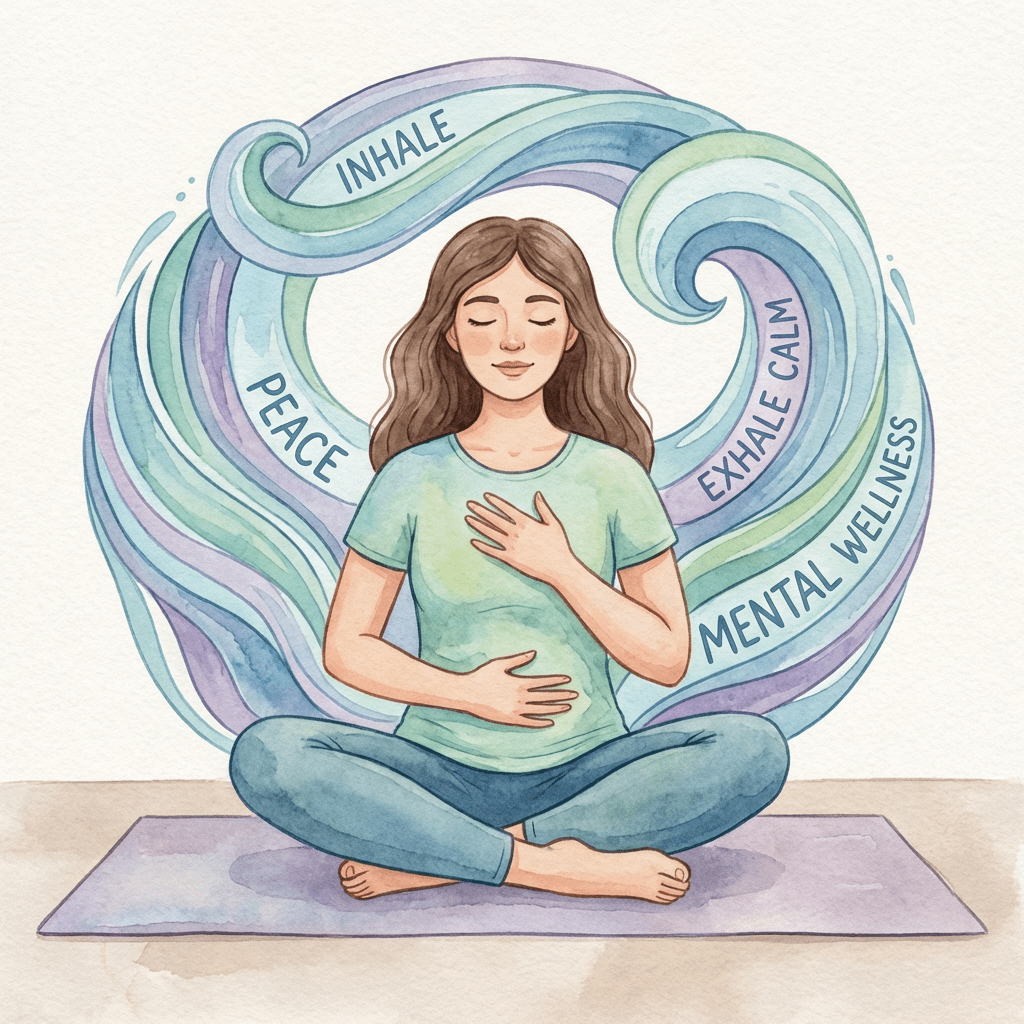
You’ve probably heard the advice to “just slow down and focus on your breath” more times than you can count. If you’re like me, you might have wondered… but why? What does the way I breathe actually have to do with my mental health?
Today, we are going to answer this question and explore why this tiny habit is such a powerhouse for your brain and body.
It’s Your First Step Toward Regulation
Slowing down to focus on your breath is like hitting the mute button on a loud movie. The movie keeps going – the thoughts in our head and our environment keep changing – but muting the noise gives us permission to focus on what our body is feeling instead of what our brain is thinking. It actually opens up space to notice what we are feeling about this specific “movie” we are living in.
It Flips the “Stress Switch”
Think of your breath as a remote control for your nervous system. Imagine you are sitting through an annoying movie; you can choose to stay stuck in it, or you can pick up the remote and change the channel. While changing the channel doesn’t change the fact that the first movie is still playing somewhere else, it means you have chosen to focus on a different show.
Your breath works the same way:
- Short, shallow breaths send the message to stay on high alert.
- Deep breaths (specifically with an exhale that is longer than the inhale) tell the body it is safe to calm down.
You Are Not Your Thoughts
Both of these actions – muting the outside noise to focus inward and signaling to our body that it is time to make a change – empower us to separate from our thoughts. The average person has about 20,000 thoughts a day. That is a lot of noise!
Focusing on your breath allows you to take a gentle step back. It helps you realize that while a negative thought might be present, you don’t have to “feed” it or own it. You can acknowledge it’s there and then simply return your focus to your breathing.
Take A Pause
Whether you prefer to guide yourself or listen to a pro, find what works for you. Maybe you’re someone who can close their eyes and simply count your inhales for five and your exhales for seven. Or, maybe you’re someone who prefers a guided meditation.
Here are four of my favorite guided meditations to get you started:
- Belly Breathing Exercise by Indiana Unviersity School of Medicine
- Letting Go Meditation by Ally Boothroyd
- 5 Minute Calming Breathwork by Yoga with Adrienne
- Square Breathing Exercise by Caitlin K’eli Yoga
A Final Thought on Mind Wandering
Our minds wander a lot. Your body might be sitting at a fancy restaurant with loved ones or standing on a beach trying to enjoy nature, but your brain is somewhere else entirely. This “mind wandering” is natural, but it can often create feelings of discontent and unhappiness.
By learning to focus on our breath and anchoring ourselves to the present moment, we can actually increase our feelings of happiness. Like all things in life, this takes practice. If this is a habit you want to build, I have a tool to help you measure your progress.
Link to Habit Tracker
In Summary
When you choose to spend just three minutes focusing on your breath, you aren’t just “relaxing” – you are actively training your brain. You are practicing the skill of muting the noise, switching the channel on your stress response, and choosing to be present in your own life. You are worth those three minutes.
 Angie Schilaty
Leave a comment